Mission Overview
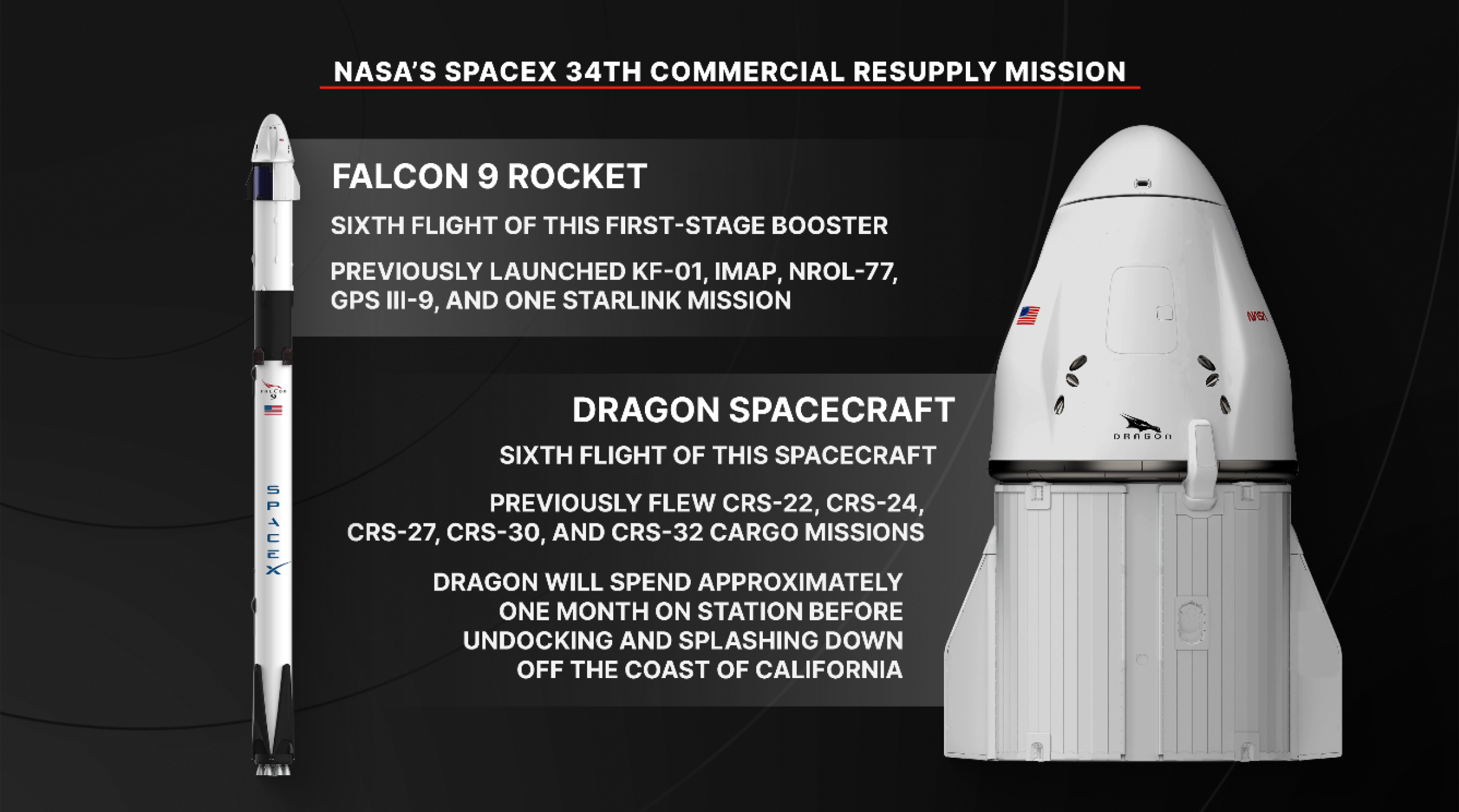
SpaceX and NASA are gearing up for the 34th commercial resupply mission to the International Space Station (ISS), targeting a mid-May liftoff. This mission, designated CRS-34, will see a SpaceX Dragon spacecraft loaded with approximately 6,500 pounds of scientific research, crew supplies, and equipment, launched atop a Falcon 9 rocket from Launch Complex 40 at Cape Canaveral Space Force Station in Florida.
Launch and Docking
The Falcon 9 rocket will propel the Dragon spacecraft into orbit, setting it on a trajectory to rendezvous with the ISS. Once it reaches the orbital outpost, Dragon will autonomously dock to the forward port of the station's Harmony module. This autonomous docking capability has become a hallmark of SpaceX missions, ensuring a safe and precise connection to the station.
Cargo and Supplies
Beyond the essential supplies for the ISS crew, Dragon will carry a suite of new scientific experiments that promise to expand our understanding of microgravity and space phenomena. The cargo also includes hardware for station maintenance and upgrades, reflecting the ongoing commitment to keeping the ISS operational for groundbreaking research.
Scientific Payloads Aboard Dragon
Three notable experiments are highlighted for this mission, each designed to answer fundamental questions about life and physics in space.
ODYSSEY: Testing Microgravity Simulators
The ODYSSEY experiment aims to evaluate how well Earth-based microgravity simulators replicate actual conditions in space. Researchers will study bacterial behavior in the microgravity environment of the ISS and compare results with those from simulators on Earth. This work could validate ground-based models, making it easier to conduct preliminary experiments without leaving the planet.
STORIE: Monitoring Space Weather
STORIE (Space Telescope for Orbital Radiation and Ionization Effects) will monitor charged particles in orbit around Earth. These particles respond to space weather—phenomena like solar flares and geomagnetic storms—that can affect critical assets such as power grids, satellites, and astronaut health. By gathering data, STORIE could help researchers predict and mitigate space weather impacts.
Laplace: Understanding Dust in Space
The Laplace experiment will examine the movement and collision of dust particles in microgravity. This research aims to shed light on the dynamics of dust in space, which is crucial for understanding planetary formation and the origins of our solar system. Insights from Laplace could also inform how dust behaves in exoplanetary systems.
The ISS: A Platform for Discovery
For more than 25 years, the ISS has served as a unique laboratory, hosting over 4,000 experiments from scientists in more than 110 countries. Microgravity allows for research that cannot be replicated on Earth, from fluid dynamics to biological growth patterns. The station also plays a key role in preparing for long-duration missions to the Moon under NASA's Artemis program and future missions to Mars. Each resupply mission, like CRS-34, delivers the lifeblood of this research—whether it's new experiments, replacement parts, or fresh supplies for the crew.
How to Watch the Launch
NASA will provide live coverage of the launch and docking on multiple platforms. Viewers can tune in on NASA+, Amazon Prime, and NASA's YouTube channel. For a full schedule and additional viewing options, visit NASA's online resources or follow the agency on social media.
Stay updated with the latest mission milestones and discover how this resupply flight continues to push the boundaries of science and exploration.