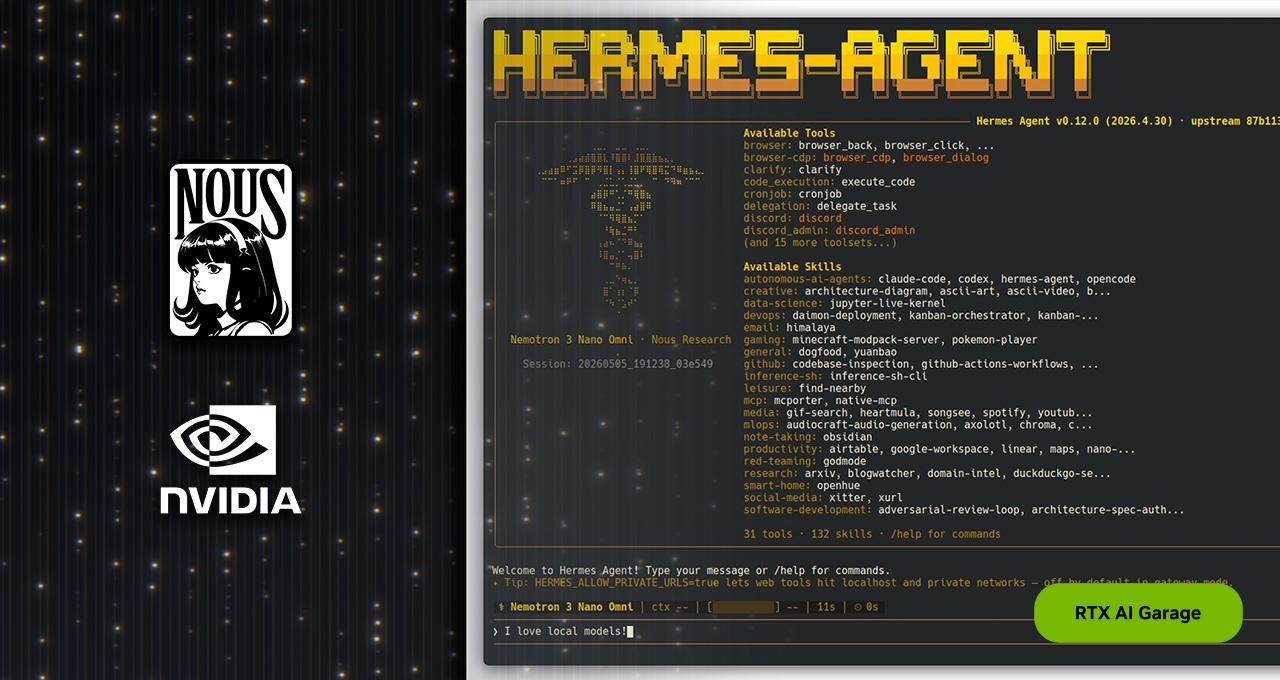
Welcome to the world of Hermes Agent, an open-source AI framework by Nous Research that redefines local agentic intelligence. Unlike traditional agents, Hermes learns from every interaction, refines its own skills, and runs reliably on consumer hardware like NVIDIA RTX PCs and DGX Spark. Below, we answer the most pressing questions about this self-improving system and its cutting-edge capabilities.
What is Hermes Agent and why is it gaining so much attention?
Hermes Agent is an open-source framework designed to create reliable, self-improving AI agents. Developed by Nous Research, it quickly surpassed 140,000 GitHub stars and became the most-used agent on OpenRouter. Its appeal lies in being provider- and model-agnostic, optimized for always-on local use on NVIDIA RTX PCs, RTX PRO workstations, and DGX Spark. Unlike many agents that require constant debugging, Hermes delivers consistent results even with smaller context windows, making it ideal for local, always-on deployments.
How does Hermes achieve self-improvement?
Hermes features self-evolving skills. Every time it tackles a complex task or receives feedback, it saves its learnings as a reusable skill. Over time, it adapts and refines its abilities without human intervention. This continuous learning loop ensures that the agent becomes more efficient and accurate with each interaction, all while running locally on your machine.
What are Hermes’ four standout capabilities?
Hermes sets itself apart with four key features:
- Self-Evolving Skills: The agent writes and refines its own skills based on experience and feedback.
- Contained Sub-Agents: Sub-agents are short-lived, isolated workers dedicated to one subtask, keeping context tidy and reducing confusion.
- Reliability by Design: Every skill, tool, and plugin is curated and stress-tested by Nous Research, ensuring stable performance even with 30B-parameter models.
- Same Model, Better Results: Using identical LLMs, Hermes outperforms other frameworks because it acts as an active orchestration layer, not a thin wrapper, enabling persistent, on-device agents.
What hardware is ideal for running Hermes locally?
NVIDIA RTX GPUs, NVIDIA RTX PRO workstations, and the DGX Spark are purpose-built for Hermes Agent. Since Hermes is optimized for always-on local use, the quality of hardware directly impacts user experience. These systems provide the memory and compute power needed to run frameworks like Hermes and the underlying LLMs at full speed, around the clock, without cloud dependency.

What is Qwen 3.6 and how does it relate to Hermes?
Qwen 3.6 is a new series of high-performance, open-weight LLMs from Alibaba. The 27B and 35B parameter models outperform previous 120B and 400B models while using far less memory (roughly 20GB for the 35B model). These models are ideal for running local agents like Hermes on NVIDIA RTX and DGX Spark hardware, bringing data center-level intelligence to personal devices.
How does Hermes handle sub-agents differently from other frameworks?
Hermes treats sub-agents as contained, short-lived workers dedicated to a single subtask with a focused context and set of tools. This design keeps task organization tidy, minimizes confusion, and allows the main agent to run with smaller context windows. In contrast, many other frameworks create messy, overlapping contexts. Hermes’ approach is particularly beneficial for local models with limited memory, ensuring smooth operation even with complex, multi-step tasks.
Why is reliability a standout feature of Hermes?
Reliability is built into Hermes from the ground up. Nous Research curates and stress-tests every skill, tool, and plugin that ships with the agent. This rigorous process ensures that Hermes just works even with 30-billion-parameter-class local models, without the constant debugging most agent frameworks require. This reliability makes Hermes suitable for 24/7 always-on use, a critical requirement for productive AI agents.