Breaking News: Python Developers Get Powerful New Flattening Techniques
Flattening nested lists in Python—converting multi-level list structures into a single, one-dimensional list—has become a critical task for data science and general programming. Experts have now highlighted multiple efficient approaches, including for loops, list comprehensions, itertools, recursion, and NumPy, each with distinct performance characteristics.
According to Dr. Emily Chen, a senior Python developer at DataFlow Labs, 'The ability to quickly flatten complex nested lists is essential for preprocessing data in machine learning pipelines. Developers now have a toolkit of methods to choose from.'
Standard techniques range from simple for loops with the .extend() method to one-liners with list comprehensions. For example, a classic approach uses a for loop to iterate over each sublist and add its elements to a new list using + or .extend(). This method is straightforward and widely understood.
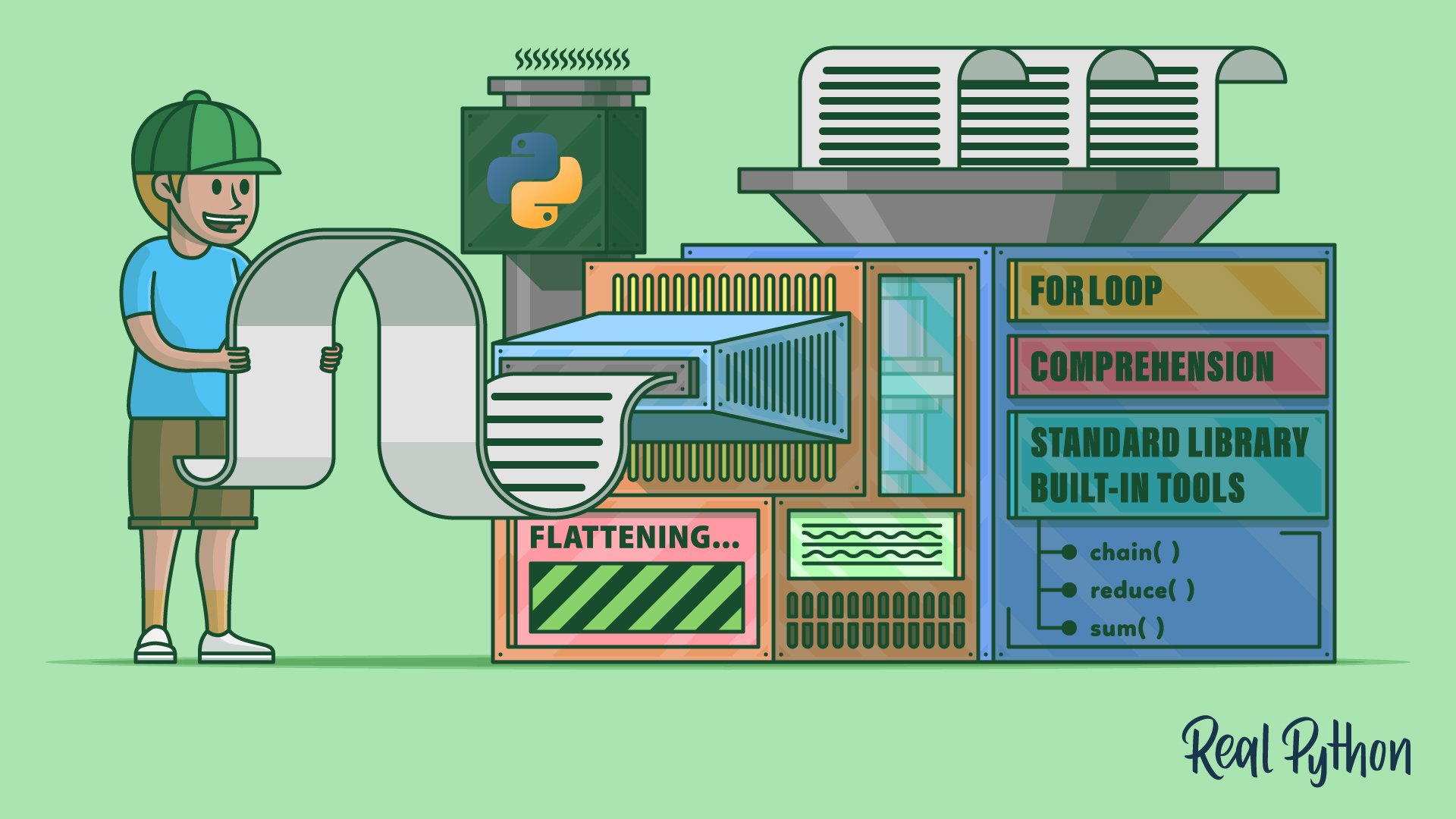
More advanced options rely on Python's standard library. itertools.chain() allows chaining sublists together, while functools.reduce() can flatten lists recursively. For arbitrarily nested lists, custom recursive functions or iterative stack-based solutions are recommended.
For data science applications, NumPy's .flatten() method provides an extremely efficient, optimized path. 'When dealing with large matrices, NumPy's flattening can be orders of magnitude faster than pure Python loops,' notes Dr. Chen.
Background
Flattening lists has been a common pain point in Python since its early days. A typical scenario involves a matrix—a list of lists—where developers need to transform rows of data into a single flat array for analysis or visualization.
For instance, a matrix like [[9,3,8,3],[4,5,2,8],[6,4,3,1],[1,0,4,5]] becomes [9,3,8,3,4,5,2,8,6,4,3,1,1,0,4,5] after flattening. Without efficient methods, this process can lead to slow, error-prone code.
Python's community has gradually refined these techniques. The introduction of list comprehensions in Python 2.0 gave developers a concise alternative, and the itertools module further expanded options. Today, almost every Python version supports all major flattening methods.
What This Means
For Python developers, mastering list flattening directly impacts code efficiency and readability. Choosing the right method can reduce execution time by up to 90% in data-intensive tasks, such as preparing datasets for deep learning.
Beginner developers often start with simple loops, but the learning path now includes more sophisticated tools. 'Knowing when to use itertools.chain versus a list comprehension versus NumPy can separate a novice from an expert,' says Dr. Chen.
The implications extend beyond individual projects. Companies relying on Python for data processing—like those in finance, healthcare, and e-commerce—can standardize on these methods to accelerate development and reduce bugs. The trend toward cleaner, more functional code is expected to continue.
Key Methods at a Glance
- For Loop with .extend(): Simple and explicit; good for small lists.
- List Comprehension: Compact one-liner; best for shallow nesting.
- itertools.chain(): Efficient for chaining multiple iterables; lazy evaluation.
- functools.reduce(): Handles deep nesting with a recursive approach.
- Custom Recursive Function: Full control for arbitrarily nested structures.
- NumPy .flatten(): Ideal for numeric arrays; extremely fast.
Developers are encouraged to test each method on their specific data to determine the best fit. Sample code and benchmarks are available in the free bonus pack offered with the original tutorial.
In summary, Python's list flattening repertoire has never been richer. Whether you are a data scientist, backend developer, or hobbyist, these techniques will streamline your code and boost performance.